N. S. Bendre — A Master's Legacy
Narayan Shridhar Bendre (1910–1992) was one of the defining figures of 20th-century Indian art — painter, educator, and founding force of the celebrated Baroda Group. Kiran Kulkarni, Co-Founder of the Master Vault Art Fund and Board Chair of West Nottingham Academy, is Bendre's son-in-law.
The Kulkarni Family Collection includes important works by Bendre and K. K. Hebbar.

N. S. Bendre: Remembering an Artist and a Way of Seeing
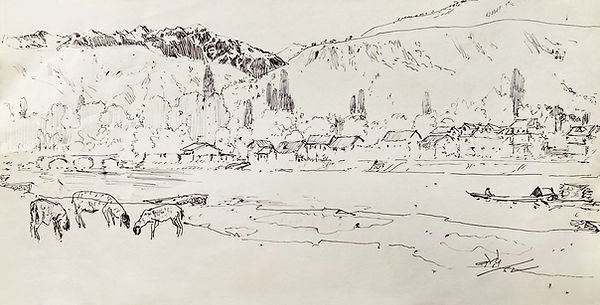
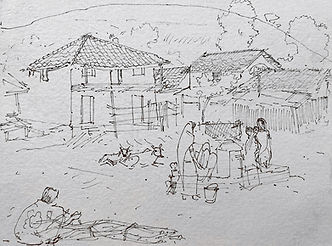
To speak of N. S. Bendre is to speak not only of an accomplished artist, but of a man who possessed an extraordinary capacity to look at the world with freshness and wonder. His paintings are known and admired for their colour, composition and modernist vision. Yet there is something particularly intimate about his sketches. In them, we encounter the artist almost directly —observing, searching, responding. A few confident strokes could capture a human figure, a face, a landscape or a passing moment. Nothing seems unnecessary. Every line has a purpose.
Perhaps that is what makes Bendre's drawings so moving. They remind us that art begins with attention.
He looked carefully at people and places, at the familiar scenes of everyday Indian life, and found in them a quiet beauty. A village, a marketplace, a tree, a group of people gathered together — these were not merely subjects to be recorded. They were opportunities to understand life more deeply.
Bendre's artistic journey was one of continual exploration. Born in Indore in 1910, he received his early training there and later studied in Bombay. His travels through India exposed him to an extraordinary variety of landscapes, cultures and traditions. At Santiniketan, he encountered an artistic environment that encouraged freedom of thought and a deeper engagement with Indian visual traditions.
I'm a paragraph. Click here to add your own text and edit me. It's easy.
He continued to grow by looking beyond India as well. His exposure to European modernism brought new possibilities into his work. Cubism, Expressionism and other modern approaches became part of his visual vocabulary. Yet Bendre was never simply an imitator. He absorbed what he encountered and transformed it into something distinctly his own. That ability to remain open to change was one of his great strengths.
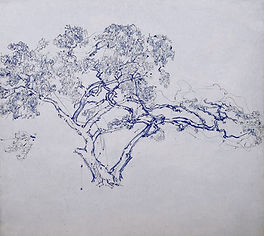
He experimented throughout his career, moving between different approaches to colour, form and composition. In his later work, his distinctive use of pointillist techniques created paintings that shimmer with light and energy. But whatever the style, there remained a recognizable sensitivity — an understanding that a painting should do more than represent what is in front of the eye. It should convey something of the experience of seeing. Perhaps even more important was Bendre's contribution as a teacher.
When he joined the Faculty of Fine Arts at Maharaja Sayajirao University in Baroda in 1950, he entered an environment that would become one of the most influential centres of modern Indian art. As a teacher and mentor, he encouraged students to think independently, to experiment and to discover their own voices. His influence therefore extended far beyond his own paintings.
He helped nurture a generation of artists and played an important role in the development of the Baroda Group of Artists. His legacy can be measured not only in the works he left behind, but also in the creative lives he helped shape.
And yet, after all the recognition, the awards and the achievements, it is perhaps the quietness of his sketches that brings us closest to him.
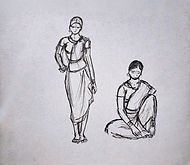
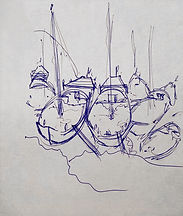

There is something deeply human in the act of sketching.
The artist sits before a subject. He observes. He pauses. He makes a line. Then another. Gradually, a figure emerges.
In Bendre's hands, that simple act became poetry.
His sketches do not shout for attention. They invite us to pause beside them. They ask us to notice the gesture of a body, the character of a face, the rhythm of a landscape. They remind us that beauty does notalways announce itself. Very often, it is hidden in ordinary moments — waiting to be seen.
This may be Bendre's most enduring gift.

He taught us, through his art, that seeing is an active form of understanding.
To look closely is to discover.
To observe patiently is to appreciate.
And to draw even the simplest subject with honesty is to acknowledge its worth.
N. S. Bendre passed away in 1992, but his work continues to speak across generations. His paintings remain part of the story of modern Indian art, while his drawings preserve something more personal — the record of an artist continually curious about the world around him.
When we look at a Bendre sketch today, we are not simply looking at a drawing made decades ago.We are sharing, for a brief moment, the artist's act of looking. And perhaps that is the finest tribute we can offer him:to slow down, to look carefully, and to see the beauty that is already there.
For N. S. Bendre, art was not merely about putting colour on canvas or lines on paper.
It was about discovering the extraordinary in the everyday.
His legacy is not only the art he created, but the way he taught us to see.